
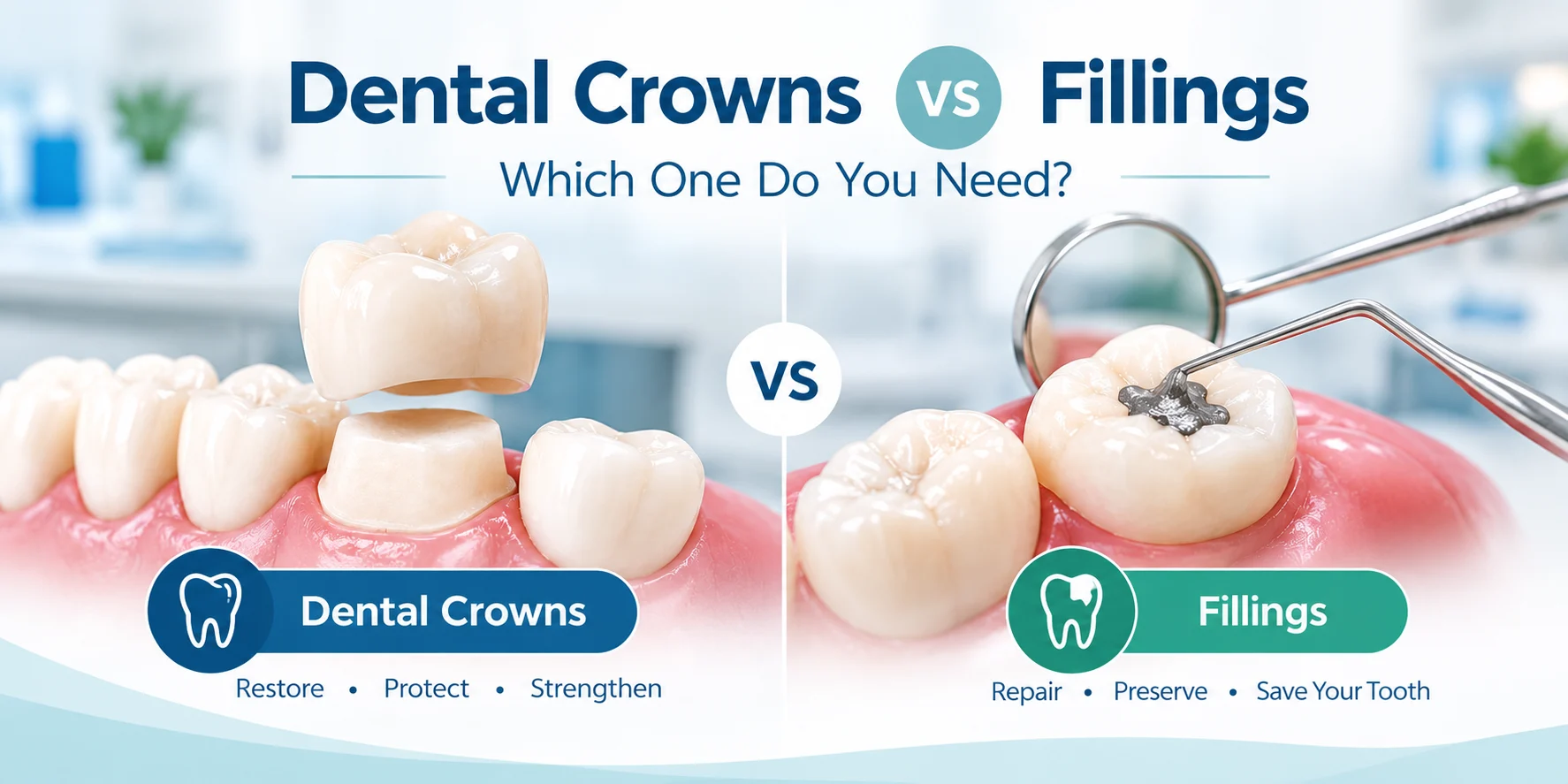
If you have a cavity, chipped tooth, cracked tooth, or tooth that has been weakened by decay, you may hear your dentist discuss a filling or crown.
But how do you know which one may be appropriate?
The answer depends on factors such as the amount of healthy tooth structure remaining, the location of the tooth, the extent of the damage, your bite, and the overall condition of the tooth.
Understanding the difference between a dental crown and filling can help you have a more informed conversation with your dentist.
Robertson Family Dentistry provides crown and bridge services for patients in Bells Corners and the surrounding Ottawa area.
What Is a Dental Filling?
A dental filling is a restoration used to repair a tooth affected by decay or certain types of damage.
During the procedure, the dentist removes the affected portion of the tooth and places a filling material into the prepared area.
The purpose is to restore the shape and function of the tooth while preserving as much healthy tooth structure as appropriate.
Fillings may be considered for:
- Cavities
- Small areas of tooth decay
- Certain minor fractures
- Small areas of tooth damage
- Some chipped teeth
The appropriate material and technique depend on the individual tooth and clinical situation.
What Is a Dental Crown?
A dental crown is a restoration designed to cover the visible portion of a tooth.
Unlike a filling, which generally fills a specific area of a tooth, a crown covers the tooth to restore its shape and function when more extensive restoration is needed.
Crowns may be considered for teeth that are:
- Significantly weakened
- Heavily restored
- Cracked or damaged
- Structurally compromised by decay
- Treated with a root canal in certain situations
What are Dental Crowns and Bridges?
A common question is “What are dental crowns and bridges?”
A dental crown is used to restore an individual tooth, while a dental bridge can replace one or more missing teeth by using crowns or other supporting components.
Although crowns and bridges are often discussed together, they serve different purposes.
A crown may be used to:
- Restore a damaged tooth
- Cover a weakened tooth
- Support a tooth following certain procedures
- Restore tooth shape and function
A bridge may be used to:
- Replace a missing tooth or teeth
- Use neighbouring teeth or other support as part of the restoration
Your dentist can determine whether a crown, bridge, filling, implant, or another option is appropriate for your situation.
Dental Crown vs Filling: What Is the Difference?
The main difference is how much of the tooth the restoration covers and how much tooth structure needs to be restored.
| Dental Filling | Dental Crown |
| Fills a prepared area of the tooth | Covers the visible portion of the tooth |
| Often used for cavities | Often considered when more extensive restoration is needed |
| Generally preserves the remaining tooth structure around the restoration | Provides coverage around the tooth |
| May be appropriate for smaller areas of damage | May be considered for significantly weakened teeth |
| Treatment is generally more limited in scope | Requires preparation of the tooth for crown placement |
The choice is not simply about which restoration is “better.” It is about which option is appropriate for the condition of the tooth.
Crown Procedure vs Filling: How Are They Different?
The crown procedure vs. filling involves different steps.
What Happens During a Filling?
For a typical filling, the dentist:
- Examines the tooth
- Removes the affected tooth structure
- Cleans the prepared area
- Places the filling material
- Shapes the restoration
- Checks the bite
What Happens During a Crown Procedure?
A crown procedure generally involves more extensive preparation.
Depending on the situation, the process may include:
- Examining the tooth
- Preparing the tooth for the crown
- Taking a digital or traditional impression
- Creating or ordering the crown
- Placing the crown
- Checking its fit and bite
Robertson Family Dentistry also offers modern digital dental technology, including the TRIOS 3 3D Scanner, which may support digital impressions in appropriate cases.
When Might a Filling Be Used?
A filling may be considered when enough healthy tooth structure remains, and the damaged area can be restored without full coverage.
For example, your dentist may discuss a filling for:
- A small or moderate cavity
- Limited tooth damage
- Certain minor chips
- Areas where a direct restoration is appropriate
The exact treatment depends on the tooth and the extent of the damage.
When Might a Crown Be Used?
A crown may be considered when a tooth needs more extensive restoration or coverage.
Possible situations include:
- A significantly weakened tooth
- Extensive decay
- A large existing filling
- Certain cracked teeth
- A tooth that has undergone root canal treatment
- Significant structural damage
Not every tooth that has had a root canal automatically requires a crown. Your dentist will assess the tooth and determine what type of restoration may be appropriate.
Dental Crown or Filling After Root Canal?
One common question is:
“Should I get a dental crown or filling after a root canal?”
There is no single answer for every tooth.
After root canal treatment, the remaining tooth structure, location of the tooth, amount of damage, and biting forces may all be considered when determining the appropriate restoration.
A crown may be considered when the tooth needs additional coverage or structural support.
In other situations, another type of restoration may be appropriate.
The best approach is to have the tooth evaluated and discuss the available options with your dentist.
Crown vs Filling for a Chipped Tooth
A chipped tooth does not automatically require a crown.
Can dentists fill in chipped teeth?
In some situations, yes. A filling or bonding material may be appropriate for a smaller chip.
However, a crown may be discussed if the tooth has more extensive structural damage or requires greater coverage.
The location of the chip also matters.
Crown vs Filling Front Tooth
When considering a crown vs filling for a front tooth, your dentist may evaluate:
- Size of the damaged area
- Amount of remaining tooth structure
- Tooth colour
- Location of the damage
- Bite
- Cosmetic considerations
- Overall condition of the tooth
A smaller chip may sometimes be repaired with bonding or another conservative restoration, while a more extensively damaged tooth may require a different approach.
Crowns vs Fillings for Baby Teeth
Parents may also ask about crowns vs fillings for baby teeth.
The treatment approach for a child’s tooth can differ from treatment for an adult tooth.
Depending on the child’s age, the tooth involved, how much tooth structure remains, and how long the tooth is expected to remain in the mouth, a dentist may consider different restorative options.
Parents should discuss the available choices with their child’s dental professional rather than assuming that an adult treatment approach is appropriate for a baby tooth.
Crown vs Filling Pros and Cons
There are potential advantages and considerations associated with both restorations.
Filling
| Potential advantages | Considerations |
| Can restore a localized area of tooth damage | May not be appropriate when a tooth has extensive structural damage |
| Often preserves surrounding healthy tooth structure | The restoration’s suitability depends on the amount of remaining tooth structure |
| May be suitable for smaller cavities or areas of damage |
Crown
| Potential advantages | Considerations |
| Covers a larger portion of the tooth | Requires preparation of the tooth |
| May be considered for significantly weakened teeth | Involves a more extensive restorative procedure than a typical filling |
| Can restore the shape and function of a substantially damaged tooth | May not be necessary for every damaged tooth |
Which Is Better: Filling or Crown?
Neither option is universally better.
The appropriate choice depends on the individual tooth.
Your dentist may consider:
- How much healthy tooth remains
- Size and location of the cavity
- Whether the tooth is cracked
- Previous restorations
- Whether the tooth has undergone root canal treatment
- Your bite
- The tooth’s location
- Your overall oral health
A filling may be appropriate for a smaller area of damage, while a crown may be considered when a tooth requires more extensive coverage.
Dental Crown vs Filling Cost
Patients frequently search for “dental crown vs filling cost.”
However, treatment costs vary depending on the specific procedure, materials, laboratory requirements, complexity, and individual dental situation.
Rather than choosing a restoration based solely on cost, the decision should be based on the condition of the tooth and the treatment option your dentist determines is appropriate.
For Robertson Family Dentistry, avoid adding pricing claims to this article unless the clinic has specifically approved current pricing information.
How Does a Dentist Decide Between a Crown and Filling?
The decision is based on the condition of the individual tooth.
Your dentist may assess:
Tooth Structure: How much healthy tooth remains after removing decay or damaged material?
Extent of Damage: Is the problem limited to one area, or is the tooth substantially weakened?
Tooth Location: Front teeth and back teeth experience different functional demands.
Existing Restorations: A tooth with a large existing restoration may require a different approach from a tooth with a small cavity.
Root Canal Treatment: A tooth that has undergone root canal treatment may require additional consideration when selecting a restoration.
Bite: The forces placed on the tooth during chewing can influence restorative planning.
How Can You Reduce the Need for Dental Restorations?
Not all cavities or tooth damage can be prevented, but good oral hygiene can support your overall dental health.
Helpful habits include:
- Brush twice daily with fluoride toothpaste
- Clean between your teeth
- Limit frequent sugary snacks and drinks
- Avoid using teeth to open packages
- Wear a mouthguard for appropriate sports activities
- Address teeth grinding or clenching with your dentist
- Attend regular dental examinations
- Follow recommended preventive dental care
Frequently Asked Questions About Dental Crowns and Fillings
What is fillings for teeth?
Dental fillings are restorations used to repair areas of teeth affected by decay or certain types of damage. A dentist removes the affected area and fills the prepared space with an appropriate restorative material.
What is a dental crown?
A dental crown is a restoration that covers the visible portion of a tooth. It may be considered when a tooth requires more extensive restoration or coverage.
Which is better, filling or crown?
Neither is universally better. A filling may be suitable for a smaller area of tooth damage, while a crown may be considered when a tooth is significantly weakened or requires more coverage.
Is a tooth crown better than a filling?
A crown is not automatically better than a filling. The appropriate restoration depends on the condition, structure, location, and needs of the individual tooth.
Can dentists fill in chipped teeth?
Yes, some chipped teeth can be repaired with a filling or bonding material. Larger or more structurally compromised chips may require another type of restoration.
Is a crown or filling better for a chipped tooth?
It depends on the size and location of the chip and how much healthy tooth structure remains. A small chip may be repaired with a conservative restoration, while more extensive damage may require greater coverage.
Should I get a dental crown or filling after a root canal?
The answer depends on the tooth and its remaining structure. Some root canal-treated teeth may benefit from a crown, while other restorative approaches may be considered in certain situations.
Are crowns or fillings better for baby teeth?
The appropriate restoration depends on the child’s age, the tooth involved, the extent of damage, and how long the tooth is expected to remain. A children’s dental examination can help determine the appropriate option.
What is the difference between a crown procedure and a filling?
A filling restores a prepared area of a tooth, while a crown covers the visible portion of the tooth. Crown treatment generally requires more extensive tooth preparation.
What are the pros and cons of crowns vs fillings?
Fillings can be suitable for smaller areas of damage and may preserve more surrounding tooth structure. Crowns provide coverage for teeth that may require more extensive restoration but involve greater tooth preparation.
How do dentists decide between a crown and filling?
Dentists consider factors such as the amount of healthy tooth structure remaining, extent of damage, tooth location, existing restorations, bite, and whether the tooth has undergone root canal treatment.
Final Thoughts: Crown or Filling?
If you are deciding between a dental crown and filling, the most important consideration is the condition of the tooth.
A filling may be appropriate for a smaller area of decay or damage, while a crown may be considered when a tooth has lost more structure and requires greater coverage.
Your dentist can examine the tooth, explain the available options, and help you understand why a particular restoration may be recommended.
For patients in Bells Corners and the surrounding Ottawa area, Robertson Family Dentistry provides restorative and family dental care based on individual dental needs.